A NTP (Network Time Protocol) appliance is a dedicated hardware device designed to provide highly-accurate, reliable and secure time-synchronization to computers, servers and network infrastructure within an organization.

Purpose
The main goal of a hardware NTP appliance is to ensure that every device on a network has the same, precise time. Synchronization is essential for many applications, such as: Log synchronization (security, auditing, forensics), Financial transactions, Telecommunications, Industrial control systems and Network management.
How A NTP Network Time Server Appliance Works
A NTP network time server typically obtains very accurate time from an atomic clock referenced time source, such as:
- GNSS satellites (GPS, Galileo, GLONASS, Beidou).
- Radio time signals (like WWVB, DCF77, or MSF).
- Other external NTP servers.
It then acts as an authoritative server on your local network, distributing precise time to other devices via the Network Time Protocol.
The device often includes:
- Single or multiple network interfaces.
- Holdover oscillators (e.g., TCXO, OCXO or Rubidium) maintain accurate time even if GPS signals are lost temporarily.
- Built-in redundancy and failover.
- Security features to maintain timing integrity.
Security & Reliability
A commercial NTP server typically provides a number of features that enhances security and reliability. Such as:
- Protection against time spoofing or tampering.
- Support for NTPv4 with authentication.
- Logging and monitoring capabilities.
- Stratum 1 accuracy (directly connects to an atomic clock referenced time source).
Dedicated NTP Servers Versus Software-Based NTP Servers
A software-based NTP Server is a general-purpose computer or VM running NTP software, such as chronyd, ntpd, or systemd-timesyncd that synchronizes its clock with external NTP sources and then serves time to clients. Therefore, a Linux or Windows server configured as an NTP stratum 2 or 3 source is an example of a software-based NTP Server.
In short, the difference between hardware NTP servers and software-based NTP servers mainly comes down to time-source, accuracy, reliability, security, and cost.
Time Source
A time server requires an accurate and reliable source of time. A hardware appliance references its primary time source to an atomic clock standard, such as GPS, GNSS or radio time references. Importantly, they have an independent source of time.
Software-based NTP Servers synchronise to other NTP servers over the internet or LAN to become a Stratum 2/3 time reference. Their source of time depends on upstream NTP sources.
Typical Accuracy
Atomic clock referenced time sources (Stratum 0) provide time to within ±30 nanoseconds to a few microseconds. While upstream NTP servers limit accuracy to ±1–10 milliseconds (LAN) or ±10–100 milliseconds (Internet).
Drift Tolerance
When a NTP device loses contact with it’s primary source of time, it’s system clock will drift away from the correct time.
Software-based solutions rely on standard crystal oscillators (XO) which have moderate to high drift and cannot maintain accurate time for an extended period. Whereas, dedicated NTP devices have temperature-compensated oscillators (TCXO) or Oven Controlled Oscillators (OCXO) to minimize system time drift and maintain an accurate time.
Reliability and Security
A dedicated NTP device provides a number of reliability and security advantages over software solutions.
Firstly, the security surface of a hardware device can be much smaller, running reduced or minimal firmware. Whereas, software solutions often depend on a larger or full operating system with more attack vectors.
Secondly, network isolation is possible, providing a fully air-gapped solution with a GPS or GNSS time reference. Conversely, a software solution needs external connectivity with an upstream, possibly internet, NTP server to provide time.
Thirdly, enhanced security is provided by security hardened NTP devices. Whereas, software solutions cannot provide the same degree of OS hardening.
Cost and Maintenance
The cost of GPS/GNSS NTP server devices varies significantly. GPS referenced TCXO based devices can cost as little as $1000. While multi-GNSS referenced devices with Rubidium Oscillators can cost as much as $10,000. Installation costs can also be moderately high because a GPS/GNSS antenna ideally requires roof-mounting with a good sky view.
Maintenance costs of a hardware solution are minimal. The system requires only firmware updates and occasional inspection of antennas and cabling.
Companies offer software based NTP solutions at very low cost. However, you should consider the cost of a LINUX or Windows server to host the software. Installation and setup costs can be moderately high, requiring OS configuration, tuning, and monitoring. Maintenance can also be time consuming, requiring regular OS patching and time source verification
Use Case Scenarios
Industries such as financial trading, pharmaceuticals and telecommunications often use NTP network time servers where regulatory compliance and high-accuracy is required. Organizations also use them in high-security scenarios where network isolation is necessary, e.g. SCADA, security and Industrial Control Systems.
Data centres and cloud infrastructure may use a hybrid architecture, with hardware Stratum-1 servers feeding internal software Stratum 2 servers.
Lab or test environments may employ software NTP servers where critical timing is not so much of a requirement.
Hybrid Architecture
Best practice uses a hybrid architecture with one or two GPS or GNSS referenced Stratum 1 NTP appliances that synchronize several software-based Stratum 2 servers. All internal clients synchronize to the Stratum 2 servers.
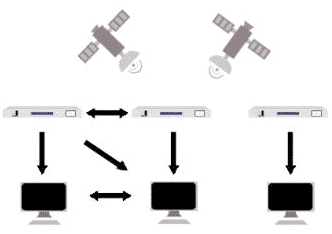
The adoption of a hybrid architecture provides a number of benefits:
- High accuracy.
- Internal redundancy.
- Isolation from the Internet.
- Lower cost scalability.
Additional Resources
https://www.ntp.org/support/vendorlinks

Accurately and reliably synchronise the time on computers and network infrastructure in your organization with TimeTools TA-Series range of GNSS NTP time server appliances. We design and manufacture the TA-Series in the UK to provide:
- Advanced, GPS and Multi-GNSS Receivers For Reliable Reception Of The GNSS Satellite Systems.
- Security-Hardened, Enterprise-Class, Stratum-1 Operation.
- High-Performance For Precise Client Synchronization.
- High-Stability, Temperature-Compensated Crystal Oscillator (TCXO) For Extended Stratum-1 Operation In The Event Of Any Loss of GPS Signal Lock.
- Network-Optimized Gigabit Ethernet (GbE).
- Powerful, Easy To Use, Web Interface With Command Line Interface For Advanced Users.
- CE and UKCA Compliant With Full EMC and Electrical Safety Test Reports.